
What I learned about life from Kingdom: Two Crowns
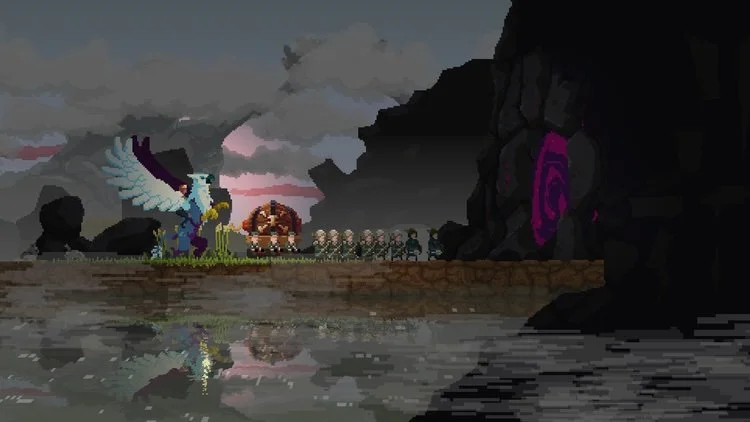
Screenshot from what turns out to be the endgame of Kingdom: Two Crowns, but you’d never know that when you start the game.
Kingdom: Two Crowns is a video game that I think you’re supposed to play with another person, but that is not how I play video games. This is how I play video games. I learn them like a language and scrape up the lessons they teach me either on purpose or by accident. This is what I learned from Kingdom: Two Crowns.
You play as a monarch in a 2D, deliberately old-fashioned pixel-art island kingdom. Your sole interaction with the world is the collection and distribution of coins. You can use them to hire villagers, buy them tools to assign them jobs, direct them to cut down trees or build walls or buildings. YOU cannot build anything. YOU cannot cut down a tree. You cannot do any of their jobs. But they won’t do their job unless you tell them to. It matters where you spend your energy. And nothing will get done until you decide to do it.
The reason you need to build walls is because at night—in certain difficulty levels, every night—little shadow guys will attack your kingdom. They’ll tear down your walls, attack your people, steal their tools and your money, and if they knock off your crown and take it from you, that’s it. You’re done. Dark times are inevitable. All you can do is build your defenses, withstand the night, and rebuild in the morning.
When the little shadow guys come, you have to have your defenses in place. Walls only slow them down, and you need archers to actually beat them. But if your builders are trying to fix a wall during an invasion, they’ll have their tools stolen before they can finish it. And if the shadow guys get to the bow before a villager does, you won’t have an archer. You can’t build your defenses when you’re under attack.
The game itself rarely tells you any of this. The tutorial, such as it is, is presented in the form of the ghost of your predecessor. It actually does this cute thing where you can choose from an array of character designs, and if your crown is stolen, the next monarch’s guide spirit is shaped like the last one you picked. However, the guide spirit kind of speaks in riddles. It doesn’t really tell you how to do anything beyond what button to push to dispense the coins, and once you start getting to new islands and unlocking some of the mysterious mounts and shrines, there is no information in-game on what any of it does. So there’s no way to know if the rare gems you find will be better spent by reviving the griffin that crashed from the sky or by looking into the mysterious house and meeting the hermit inside. There’s no way to know in advance what either will do, or which will better help you do what you need to do. You have to put yourself out there, gamble your limited resources and see for yourself. It might not work out, and that’s okay.
At first, the biggest goal you can even envision is survival. The game tells you to build, explore, defend, conquer. So you start trying to do that. One of the first things you will find beyond the edge of the forest—and the only thing other than the walls that you can even interact with—is a shipwreck. If you can put together enough gold, and if you can keep the builders safe while they work, you can rebuild the boat, load up a finite number of builders and archers, and escape. That’s when you find out that the island you started on isn’t the only island there is. You go to the next one, and you find something else: a stone mine. And once you unlock that, you find that you can build even stronger walls. You can train villagers to not just defend, but attack. You can have spear-wielding soldiers and knights who will venture out into the world and destroy the portals, which it turns out are where the shadowy guys are coming from. But you can’t see any of that at first. You don’t know what you’re up against, but you also don’t know what you can do yet. Not until you go find out.
Once the game starts to open up in this way—you find some mounts that give you the ability to interact with the game world at all beyond dropping coins—it opens up the other way, too. The shadowy guys start getting different. Some of them have armor and won’t go down in a single hit. Some of them are giants and become moving portals themselves, spitting out a dozen little guys at a time. Some of them are armored, too. There are even agile ones that don’t bother going after your villagers, they go straight for you, hungry for only the crown. The tactics you developed for the early islands don’t work on the later ones. But the things you learn aren’t choices you pick between, their tools in the shed. And when things get tough, you can use them all at the same time.
In the end, the main thing I learned is the first thing I learned. Your sole interaction with the world is distributing money—allocating attention and intention—and it’s the villagers who make it all real. The mounts that give you the capacity to attack, to repel, to hunt animals on your own. The hermits in the houses that let you turn farms and archer’s towers into more versatile buildings that transform your kingdom and its capabilities. And ultimately it’s them who let you deliver a bomb to the depths of the shadowy guys’ lair, and stem the tide once and for all. You can do it all. But you can’t do it alone.